Rejection
why it hurts more than it should
Last week, I taught a class on rejection. As I was preparing for the class, I was keen on addressing two things - building the ability to identify rejection or becoming aware of it, and having a framework to process it.
I was not teaching this because I've figured it out. I was teaching it because I haven't, and I've been paying close attention to that.
Personally, I have trouble with feeling or even identifying my feelings in real-time. And when I do realise what I’m feeling at some point later, I have trouble dealing with it constructively.
I tend to perceive my feelings as global and permanent. But over the years, I have learnt that I am not alone in this. In moments of vulnerability, many of us tend to let rejections hijack our identities.
I have witnessed a great deal of rejection quite intimately, in others as well as myself. I’ve mostly sat quietly beside it, watching the spiral unfold in real-time and tried to make sense of it one conversation at a time.
Until recently, I had never tried to abstract my learnings across multiple conversations. So, for the first time, I asked myself …
“Why do rejections hurt so much?”
After some introspection, I realised it’s because rejection is always much deeper than it seems.
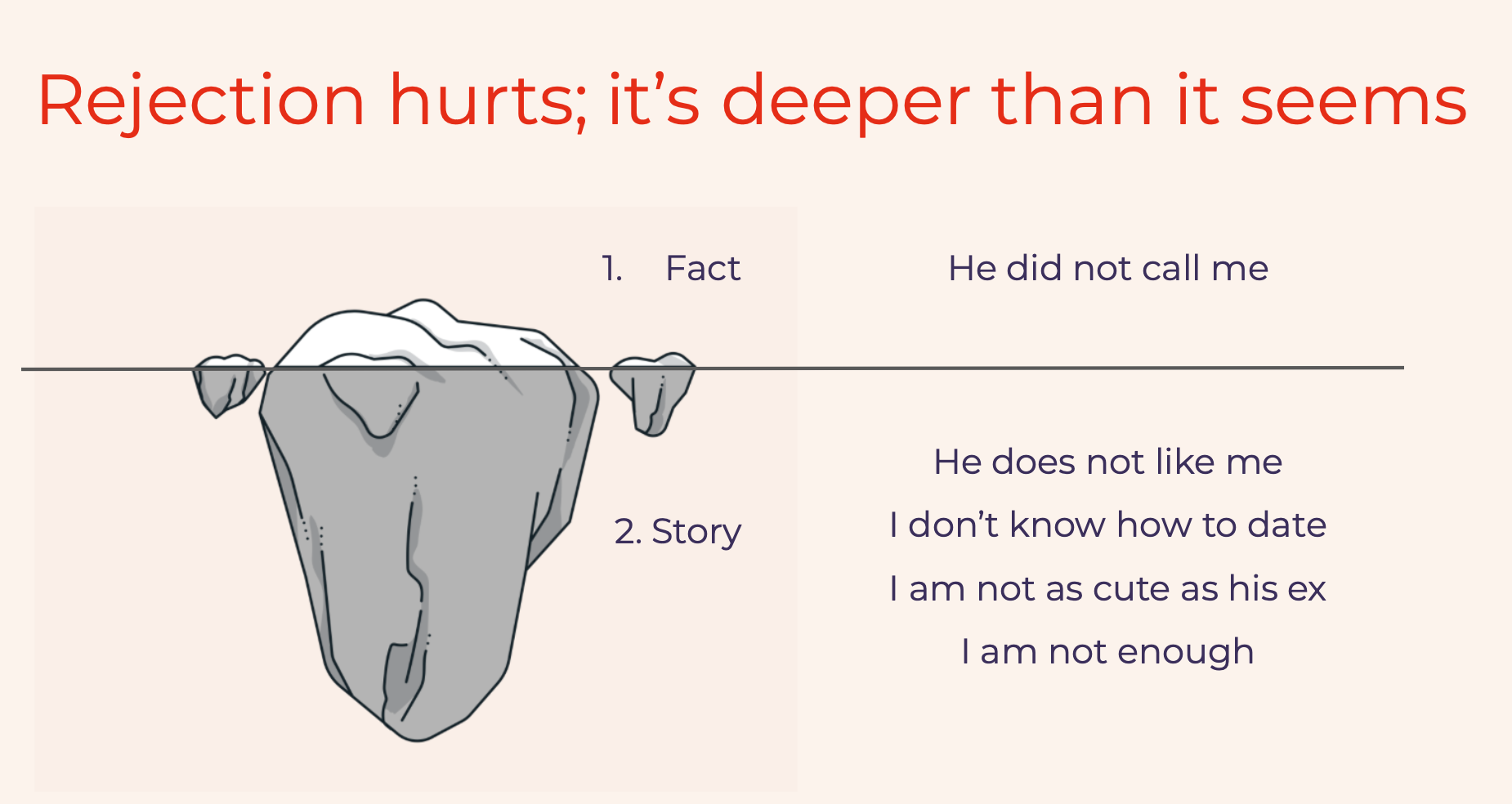
When someone rejects us (no matter how tiny the action is), it hurts not just because of the action itself, it hurts because of how we internalise it.
Let me give you an example of a micro-rejection. I’ve written earlier about how these small everyday rejections quietly accumulate in relationships.
Years ago, I went on a date. My very first. I was so excited, I couldn’t wait to plan our wedding the moment he dropped me home after our date. lol. I was 19, and this was almost two decades ago.
I sat by my Nokia 1100 waiting all evening, but the dude never called. In the first hour, I wondered why he didn’t call. By the second hour, I’d started manufacturing my own explanations. Maybe I’m not as cute as his ex. Maybe I’m a terrible dater. Maybe I didn’t matter. Maybe I’m not enough. Maybe he’s a jerk.
I wasn’t crazy, although for a while I thought I was. But turns out, this business of meaning-making in the context of social rejection is evolutionary; it’s what has helped us survive as human beings.
I mean, the fact was simple - he didn’t call. What I didn’t have all afternoon was an explanation. So, I manufactured one on my own. Ok no, several of them. None of them real.
But when I’d had enough of my fictional explanations, none of them satisfactory, I just picked up the phone and called him myself. He said he was busy buying litter for his cat.
Sigh.
He was being honest. He really was. I believed him.
Except, I felt like shit. Worse than his cat’s shit. Because his explanation only answered the fact, not the stories I'd spent the afternoon building. The cat's litter had nothing to say about whether I was cute enough, interesting enough, or worth calling back.
So those self-doubts just sat there, unattended, waiting for the next silence to fill.
I realise, the stories we begin to tell ourselves to make sense of why someone did something eventually become much bigger than the action itself.
So, I think of a rejection as an ice-berg with two parts.
The tip is the fact or what actually happened. Beneath the fact is a humongous piece of story that we’ve created in our head to make sense of that fact. Often, these stories are a function of how vulnerable we are in general or in that relationship, and how invested our identities are in that particular bond.
So the pain we experience with rejection isn’t just “they rejected” (fact). It becomes “this says something about who I am” (story). So the fact+story makes the rejection seem bigger than it is.
In that case, I wondered, if we could discern fact from story, would we be able to catch ourselves from spiralling?
Think about it …
If I asked how you’d respond to the fact alone, and not to the story, I bet you’d have a different response. Because, honestly it’s far easier to deal with than when the fact comes enmeshed with the story.
It sounds simplistic, but I think it’s not trivial to implement it in real-time. So we tried a little fun exercise to practice this model in a safe environment.
I divided the whole class into groups and gave each of them a simple fact - ‘someone seen-zoned you’, ‘someone excluded you from a party’, ‘someone cancelled a plan’ and asked them to create a 2-min skit around it.
It was fascinating to see how each group came up with a completely different story from similar facts. Afterwards, we debriefed to see if the audience could discern fact from story.
We also observed if the rejection was being internalised, or externalised. Before the exercise, most students told me they usually blame themselves when rejected. But during the skits, they didn’t. Some blamed themselves, while others blamed others. Turns out, rejection-responses aren’t universal. They are not personality traits, they’re just situational reactions.
My class is going to test the model with live-scenarios this week to see how it helps them experience rejection differently and come back with feedback.
I wanted to share the same prompt here so you could try it too.
When you feel rejected this week, I’d like you to pause for a minute and journal:
Fact: What objectively happened?
Story: What is your mind telling you it means?
Do tell me if you try it and the rejection feels even slightly different.
I haven't tried what you propose since my view is different.
I am more interested in how to get past the fear of rejection - how to get to making the phone call you did before[ending too much time wondering whether she will call?
At the end of the day - it's not the rejection itself that hurts. It's the fear of rejection and the soft let down. I much rather prefer the direct rejection since it's clear and provides closure.